

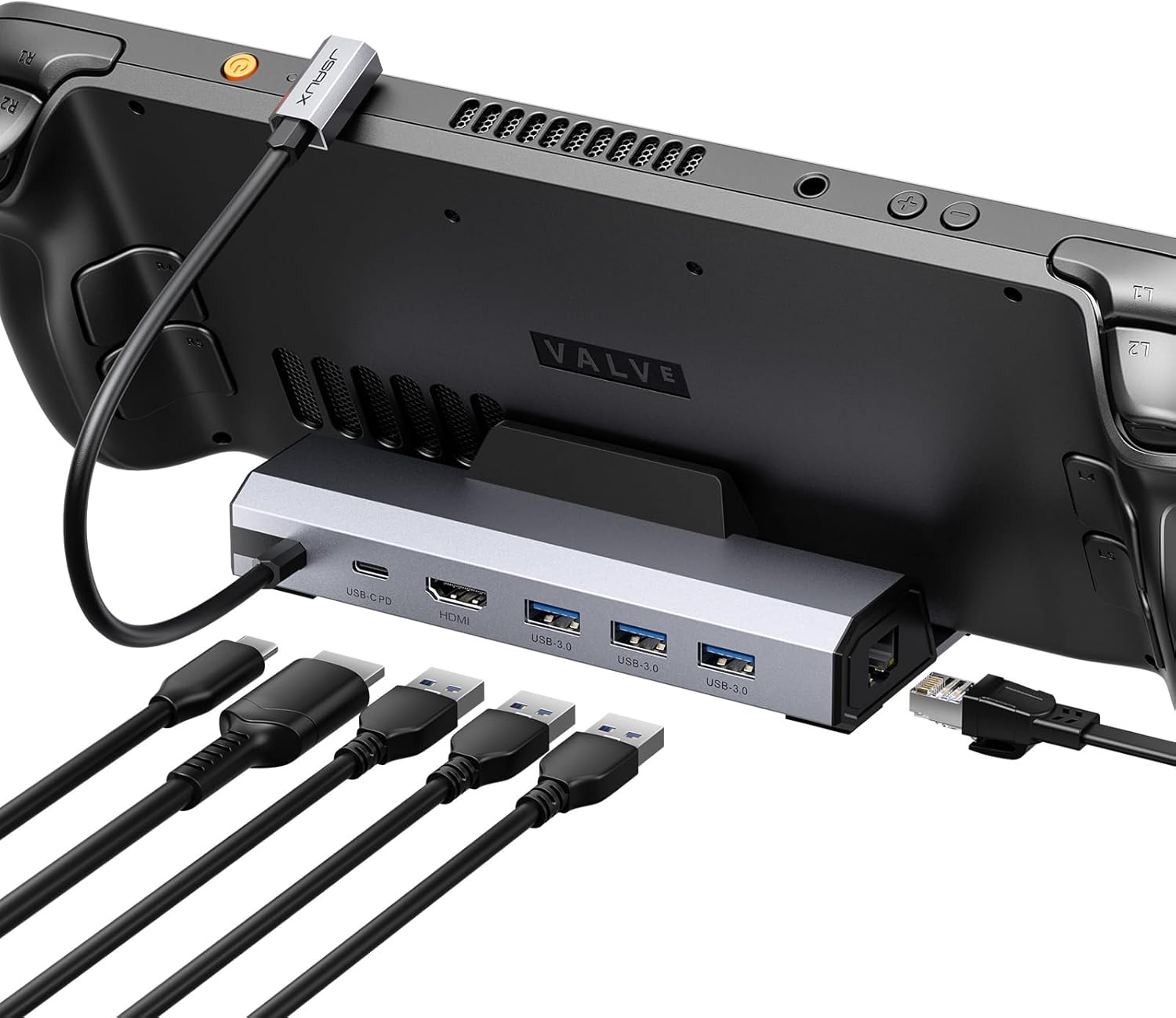
At a Glance#
Product : JSAUX 6-in-1 Docking Station for Steam Deck (HB0603)
Brand : JSAUX
Best For : Handheld owners who want to play on a TV without paying the premium for the official dock
Form Factor : Compact 6-in-1 stand dock with HDMI, Ethernet, USB, and PD passthrough
Buy Now : View on Amazon
Key Highlights:
- HDMI 2.1 output at 4K 120Hz for smooth big-screen play
- 100W USB-C Power Delivery passthrough keeps the handheld charged while docked
- Gigabit Ethernet for lag-free online play and fast downloads
- Three USB 3.0 ports for controllers, keyboard, mouse, or storage
- Works with Steam Deck LCD/OLED, ROG Ally / Ally X, Legion Go / Go 2 / Go S, and MSI Claw
Who Should Buy This#
The JSAUX 6-in-1 is for handheld owners who want the docked, big-screen experience without buying Valve's official station. Valve's dock is excellent and made from the same quality plastic as the Deck, but it is sold mainly through Steam and costs a lot more. The JSAUX matches it on the essentials — HDMI, Ethernet, USB, and 100W charging — and is a fraction of the cost on Amazon.
Perfect for:
- Steam Deck owners who want couch or desk play on a monitor or TV
- Multi-handheld households — one dock for a Deck, ROG Ally, Legion Go, or MSI Claw
- Online players who want wired Gigabit Ethernet instead of Wi-Fi
- Anyone weighing the official dock who wants the same core features for less
If that matches how you would use it, check current availability: View on Amazon
Design & Build Quality#
The JSAUX 6-in-1 is a slim aluminium bar with a fold-out cradle that props the handheld at a comfortable viewing angle while feeding video, power, and data through a single USB-C connection. JSAUX gives the material as TPE and aluminium and the unit as 140 x 77.5 x 36 mm and 141 g, so this is a light bar rather than a heavy weighted base.
Everything routes through one cable to the handheld, so setup is plug-and-play: connect HDMI to your TV, drop in your charger, and the Deck outputs to the big screen. It is designed to sit permanently by the TV, so you dock and undock in one motion.
Key Features#
4K 120Hz HDMI 2.1#
The upgraded HDMI 2.1 port outputs up to 4K at 120Hz — double the refresh rate of older 4K-60 docks. For a handheld that often targets 60fps you may not always max it out, but the headroom means smoother motion and future compatibility with high-refresh displays.
100W USB-C Passthrough Charging#
The dock passes up to 100W of USB-C Power Delivery to the handheld while you play, so a docked session never drains the battery. One honest note: the dock does not include a charger — you use your own USB-C PD brick, and a 100W unit is recommended to hit full speed (a Steam Deck or ROG Ally will still charge from a smaller one, just slower). If you need one, see our best 100W GaN chargers.
Gigabit Ethernet + Three USB 3.0 Ports#
Wired Gigabit Ethernet cuts the lag and slow downloads of Wi-Fi, and the three USB 3.0 ports let you plug in a controller, a keyboard and mouse, or external storage at the same time. JSAUX rates each USB-A port at 5V/1A, so a bus-powered portable drive sits close to the limit. This is what turns the handheld into a genuine living-room or desktop setup.
Broad Handheld Compatibility#
The 6-in-1 works across Steam Deck LCD and OLED, ROG Ally and ROG Ally X, Legion Go, Legion Go 2 and Legion Go S, and the MSI Claw. The things to check: JSAUX lists the ROG Xbox Ally and Xbox Ally X as not compatible, and its own spec sheet also rules out the Nintendo Switch and Switch 2. If the Xbox Ally is your handheld, JSAUX sells a separate dock built for it. Match your device to the list and it is plug-and-play.
Specs#
Compatibility : Steam Deck LCD/OLED, ROG Ally / Ally X, Legion Go / Go 2 / Go S, MSI Claw
Not Compatible : ROG Xbox Ally / Xbox Ally X, Nintendo Switch, Nintendo Switch 2
Video : HDMI 2.1, up to 4K at 120Hz HDR (10-bit, RGB 4:4:4); also 2K at 144Hz
Audio : eARC / ARC compatible, up to 192kHz / 24-bit decoding
Charging : USB-C Power Delivery passthrough, up to 100W (charger not included)
Network : Gigabit Ethernet (RJ45)
USB : 3 x USB-A 3.0, up to 5Gbps, 5V/1A output each
Connection : Single USB-C to the handheld
Size and Weight : 140 x 77.5 x 36 mm, 141 g
Model : HB0603S (listed on Amazon as HB0603)
Pros & Cons#
Pros:
- Matches the official dock's core features for far less money
- HDMI 2.1 4K 120Hz output with 100W charging passthrough
- Wired Gigabit Ethernet plus three USB 3.0 ports
- Works across Steam Deck, ROG Ally, Legion Go, and MSI Claw
- Compact aluminium stand with anti-slip grip that holds the handheld at a viewing angle
Cons:
- No DisplayPort — HDMI only, unlike the official Valve dock
- No charger in the box; you supply a USB-C PD brick
- Not compatible with the ROG Xbox Ally or Xbox Ally X
The Verdict#
The JSAUX 6-in-1 is the smart-money Steam Deck dock. It delivers the docked essentials — 4K 120Hz HDMI, Gigabit Ethernet, USB 3.0, and 100W passthrough charging — and matches the official Valve dock everywhere except DisplayPort, while costing far less and being easy to grab on Amazon. Unless you specifically need DisplayPort or already live inside Valve's ecosystem, this is the one to buy.
Buy it — View on Amazon — if your handheld is on the fit list and you want big-screen play without the premium. Just remember to pair it with a 100W USB-C charger.
Building out your handheld setup? See our tomtoc Steam Deck & ROG Ally carrying case review, the best power banks for handheld gaming, and the best MSI Claw 8 accessories.
FAQ#
Q: Does the JSAUX dock work as well as the official Valve dock? A: For everyday docked play, yes. It matches the official dock on HDMI, Gigabit Ethernet, USB, and 100W charging. The main thing the official dock adds is a DisplayPort output, which the JSAUX does not have.
Q: Does it come with a charger? A: No. You use your own USB-C Power Delivery charger. A 100W unit is recommended for full-speed charging, though a smaller one will still work more slowly.
Q: Will it work with my ROG Ally or Legion Go? A: Yes. It supports the ROG Ally, ROG Ally X, Legion Go, and Legion Go S, plus Steam Deck LCD/OLED and the MSI Claw. It does not support the ROG Xbox Ally or Xbox Ally X.
Q: Can it output 4K? A: Yes, up to 4K at 120Hz over HDMI 2.1. Actual output depends on your handheld and display, but the dock supports high-refresh 4K.
Q: Do I need Gigabit Ethernet if I have Wi-Fi? A: Not required, but wired Ethernet gives more stable online play and faster downloads than Wi-Fi, which is useful for large game updates.