

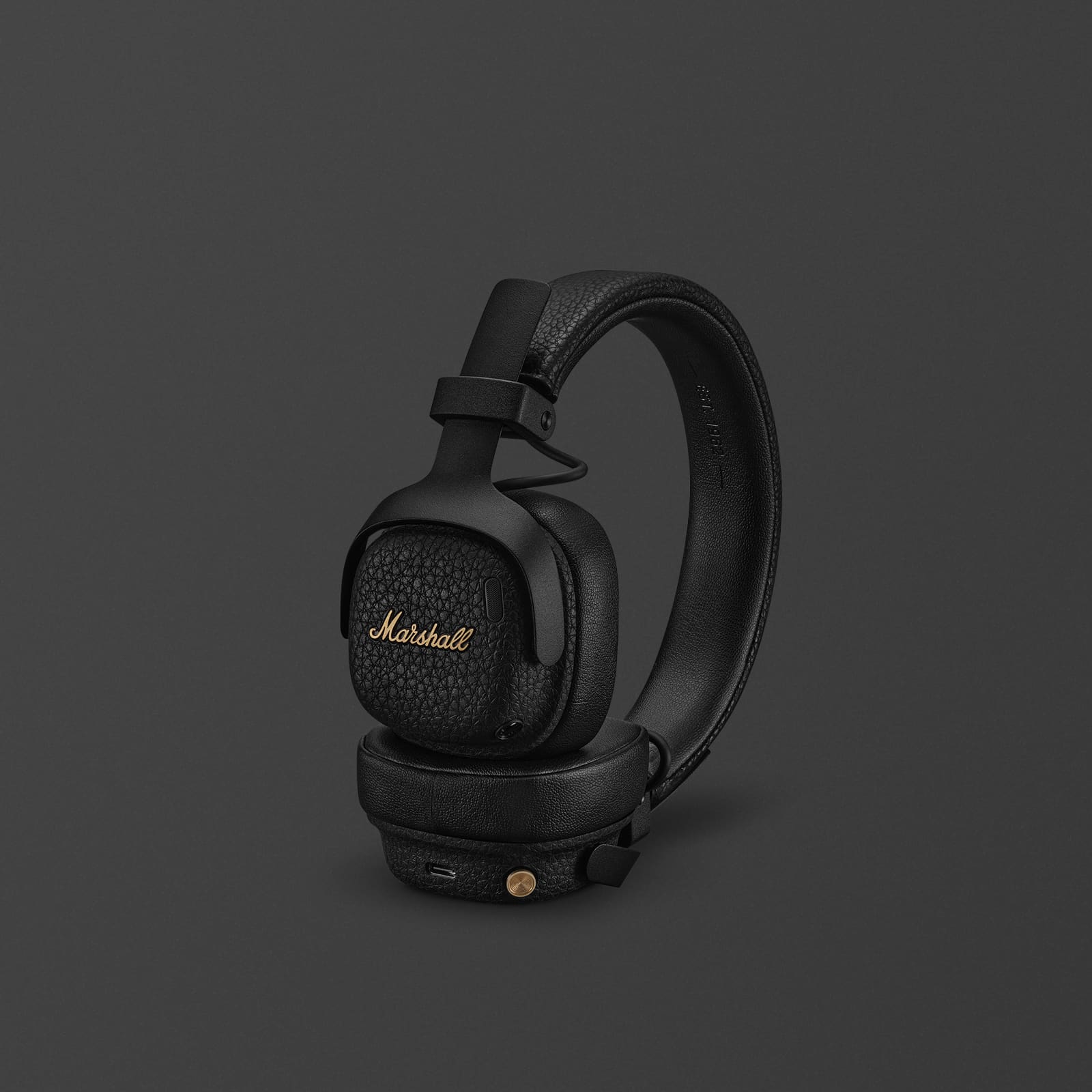
At a Glance#
Product : Marshall Milton A.N.C. Wireless On-Ear Headphones
Brand : Marshall
Best For : Commuters and travelers who want big sound and long battery without over-ear bulk
Form Factor : Foldable on-ear, 200g, adaptive ANC, replaceable battery
Buy Now : Marshall Milton A.N.C. on Amazon
Key Highlights:
- Up to 80-hour battery: You charge it a few times a month, not every night before work.
- Adaptive noise cancelling with 6 mics: The headphone reads your surroundings and hushes engine drone so you keep your focus.
- Exchangeable battery: Marshall publishes a spare-part procedure, so when the cell wears out you can swap it rather than bin the whole headphone.
- LDAC and LC3 high-res codecs: Compatible phones stream crisp, detailed audio that reveals texture cheaper headphones smear.
- Foldable 200g on-ear frame: It collapses into a jacket pocket, and ships with a pouch rather than a hard shell case.
Who Should Buy This#
The Milton A.N.C. is built for people who found flagship over-ears too heavy, too hot, or too disposable. Marshall took features usually locked behind large over-ear cans and fit them into a compact on-ear frame. It targets the listener who values portability and longevity as much as sound. If you have ever pulled bulky headphones off after two hours because your neck ached, this design speaks directly to you. It sits in a premium tier of features while staying a fraction of a flagship's bulk, and it rewards the buyer who plans to keep one headphone for the long haul.
- The daily commuter: Train and bus drone wrecks your podcasts. The adaptive ANC dulls that low rumble, and the 80-hour battery means a dead headphone never strands you mid-journey.
- The frequent flyer: Hauling a bulky headphone case eats carry-on space. The Milton folds flat into a jacket pocket, and the marathon battery outlasts long-haul flights with power to spare.
- The open-office worker: Chatter and keyboard clatter break your concentration. The ANC creates a quiet bubble, while multipoint keeps you connected to both laptop and phone at once.
- The keep-it-for-years buyer: You are tired of headphones dying when the battery does. Marshall designed the cell to come out and says it sells it as a spare, so the Milton is built to outlive its first battery.
Battery That Outlasts Your Week#
Most wireless headphones ask for a nightly charge, and a forgotten one leaves you silent on the morning commute. The Milton A.N.C. flips that habit. Marshall rates it at up to 80 hours of playback with noise cancelling off, and around 50 hours with adaptive ANC and Bluetooth both running. That is real independence from the charging cable.
Think about what those numbers mean in your week. A one-hour commute each way is ten hours a week. At 50 hours with ANC on, you charge the Milton roughly once every five weeks of commuting. Turn ANC off at your desk and that stretches further. You stop thinking about battery the way you stopped thinking about winding a watch.
The fast charge closes the gap when you do forget. A 15-minute top-up delivers around 9.5 hours of playtime, which covers a full workday and the trip home. A complete recharge takes about two hours from empty. You plug in while you shower and walk out with a headphone that lasts the week.
The one omission is wireless charging. You still reach for a USB-C cable rather than dropping the headphone on a pad. Given a battery this large, you charge so rarely that the cable barely registers as a chore. It is a fair trade for the endurance you get.
Battery anxiety quietly shapes how you use headphones. You skip noise cancelling to save charge, or leave the headphone home on a busy day. With 80 hours in reserve, that worry disappears. You run ANC all day, every day, because the cost is meaningless against a battery this deep.
This endurance is exactly why the Milton earns a place in your bag over shorter-lived rivals. A headphone you never have to think about charging is a headphone you actually carry every day. Marshall Milton A.N.C. on Amazon
A Battery You Can Actually Replace#
Here is the feature that quietly separates the Milton A.N.C. from nearly every rival: the battery is designed to come out. Marshall's spec sheet lists "Exchangeable Battery: Yes", and its launch announcement says the Milton "is repairable with a replaceable battery". Most premium headphones seal the cell inside, so when it degrades after two or three years of charge cycles, the whole product becomes landfill. Marshall broke that pattern.
Every rechargeable battery loses capacity over time. That is chemistry, not a defect. After a few years, a sealed headphone that once lasted all day starts dying by lunch, and your only option is to buy a new one. The Milton lets you swap in a fresh cell and restore full endurance instead.
It is worth knowing what the swap actually involves, because Marshall publishes the whole procedure in an official spare-part instruction sheet rather than leaving it vague. The cell sits in the right ear cup. You turn the right ear cushion anticlockwise and remove it, take out four screws with a size-1 Phillips (PH1) screwdriver, and lift the driver unit — which Marshall warns is "attached to the ear cup by a delicate cable", so it comes away carefully rather than quickly. Then you disconnect the battery connector without pulling the cable, tug the plastic tab to free the old cell, seat the new one, route its cable through the strain relief, reconnect, and screw the driver unit back down with "a light touch". It is a genuine kitchen-table repair, not a five-second hatch, and it is far more than most rivals allow.
Marshall backs the design with a commitment, not just a manual. Its Milton A.N.C. page carries a PRODUCT LONGEVITY note: "we now offer authorised repair services and access to spare parts* for Milton A.N.C. so you can keep your product in use for longer", footnoted "Battery, ear cushions and USB-C cable are available as spare parts through our website", with the outer headband and jog assembly handled through authorised service centres.
One caveat if you are buying specifically for that promise: Marshall adds its own hedge, "Availability may vary by market", and when I looked, the online headphone spares listing showed the Milton ear cushions and no Milton battery. Marshall says the part exists and points to its support page for current information, so treat the battery as committed rather than as something you can drop into a basket today.
This matters beyond your wallet. A repairable design means less waste and a headphone that ages gracefully instead of failing suddenly. Marshall pairs the exchangeable cell with over-the-air software updates and a battery-preservation setting, so the software stays current and the cell is treated gently while the hardware stays alive, and it says the Milton "contains 41% recycled material by weight". In a category built around disposability, that is a meaningfully longer horizon.
Adaptive Noise Cancelling in a Compact Shell#
Noise cancelling used to be the exclusive domain of large over-ear headphones, because sealing out sound takes space. The Milton A.N.C. brings genuine adaptive ANC into an on-ear frame, and that is a real engineering feat. Marshall's spec table lists six microphones, and its description says that "thanks to several microphones monitoring and analysing your environment, noise is blocked out automatically", with the headphone tuning its cancellation to match the room.
Adaptive means the ANC reacts in real time. Step from a quiet office onto a roaring platform and the headphone ramps up cancellation to meet the noise. Sit back down and it eases off, so it never over-processes a calm room. You get the low drone of engines, trains, and air conditioning stripped away while your music stays clean.
There is a transparency mode for the moments you need the world back. Switch it on and the microphones pipe your surroundings through, so you hear a gate announcement or a coworker's question without removing the headphone. That toggle turns one device into two experiences: sealed focus, or open awareness.
Honesty matters here. An on-ear rests on your ear rather than enclosing it, so the passive seal is looser than a true over-ear. The adaptive ANC does impressive work, but flagship over-ears with full ear cups will still cancel a hair more low-end rumble. For a headphone this small, the gap is smaller than you would expect, and for most commutes it is more than enough.
The six-mic array also handles your calls. It isolates your voice from background noise, so the person on the other end hears you and not the cafe behind you. That makes the Milton a credible work tool, not just a music toy.
The practical payoff shows up in focus. A quiet bubble lets you read, write, or listen without the constant low-level drain of ambient noise. That drain is real and tiring, even when you stop noticing it. Removing it leaves you sharper at the end of a long commute or a busy afternoon.
Sound and Codecs That Reward Good Files#
Marshall built its name on sound, and the Milton A.N.C. carries that lineage. Under each earcup sits a 32mm dynamic driver tuned for the warm, punchy signature Marshall fans expect. The frequency range reaches up to 40kHz over LDAC, so there is headroom well beyond what most headphones capture.
The codec support is where the Milton pulls ahead of typical on-ears. Marshall specifies Bluetooth 6.0 with LE-Audio, and compatibility with SBC and AAC for universal support plus LC3 and LDAC for high-resolution wireless. If you pair it with an LDAC-capable Android phone, you stream detailed, high-bitrate audio that reveals texture in a recording, the pluck of a string or the air in a vocal, that lesser codecs smear over.
Soundstage spatial audio widens the presentation so music feels like it surrounds you rather than sitting flat between your ears. Marshall describes it as its own "in-house developed spatialization algorithm" that you switch on in the app "to add depth and width to any stereo track". That description is also the honest limit: it is a pleasant widening effect applied to ordinary stereo, not the full head-tracked, positional cinema of some flagship systems. It enriches everyday listening without pretending to be a home theater.
Adaptive loudness rounds out the tuning. It adjusts the balance as you change volume, so the bass and treble stay present when you turn things down low. You get a full sound at a whisper and a controlled one when you push it. The result is a headphone that flatters both a quiet late-night listen and a loud commute.
The Marshall Bluetooth app lets you shape all of this to taste. A built-in equalizer moves the balance toward more bass, brighter treble, or a flat reference, whatever your ears prefer. You are not stuck with a single house tuning. That flexibility means one headphone can serve podcasts, rock, and orchestral tracks without ever sounding wrong.
Good sound plus real high-res codecs at this compact size is a rare combination, and it is a big reason the Milton is worth adding to your cart over a plainer on-ear. Marshall Milton A.N.C. on Amazon
Comfort, Controls, and Everyday Carry#
Weight is where on-ear headphones win, and the Milton A.N.C. tips the scale at just 200 grams. That is featherlight next to heavy over-ear flagships that press on your neck after a couple of hours. The lighter clamp and smaller pads make it friendlier for smaller heads and for glasses wearers, since the pads rest on the ear instead of sealing around the temple arms.
The fold-flat hinge is the everyday-carry hero. The Milton collapses down small enough to slip into a jacket pocket or a bag corner, and it does not ask you to carry a rigid case to do it: Marshall's box contents are the headphones, a 3.5 mm audio cord, a USB-C charging cable, the manual and a pouch. The Amazon listing calls that pouch a "Protective Case", which sets the wrong expectation — it is a soft sleeve, not a hard shell. For travelers counting every inch of carry-on space, that is the right trade.
Controls follow Marshall's signature layout. A physical control knob handles volume, playback, and calls with a tactile click you can find by feel, no guessing at a flat touch panel in your pocket. The customisable M-button is the other half: Marshall says you "choose between ANC, Transparency mode, soundstage spatial audio, EQ settings, Spotify Tap, or voice assistant". Its manual explains how those divide up — "Double press the M-button to get the music started with Spotify Tap. A single press toggles ANC modes (noise cancelling and transparency). The action for the single press can be customised in the Marshall Bluetooth app." Real buttons mean reliable control in gloves, rain, or a rushed moment.
Connectivity is modern and practical. Bluetooth 6.0 with multipoint keeps the Milton linked to your phone and laptop simultaneously, so a call on one pauses the music on the other without re-pairing. Range runs to about 10 meters, and a USB-C to 3.5mm option lets you go wired for flights or low-latency listening. The Marshall Bluetooth app ties it together with EQ, ANC settings, and those over-the-air updates.
One honest note on comfort: on-ear pads sit on the ear, which some listeners feel after a few hours. It is a different pressure from the enclosing hug of over-ears. Marshall addresses this directly — it says it "increased the size of the ear cushions from Major V", which both improves the seal and "gives you a higher sense of comfort which makes the headphones possible to wear for longer periods of time" — and it scopes the product itself to office work and commuting rather than all-day marathons. If you wear headphones from morning to night without a break, plan for the occasional pause. For most commutes and work sessions, the light weight keeps it comfortable and easy to forget.
Technical Specifications#
Driver : 32mm dynamic
Frequency Range : 20Hz-20kHz (SBC, AAC, LC3); 20Hz-40kHz (LDAC at 96kHz)
Sensitivity : 99.3 dB SPL (1mW at 1kHz)
Impedance : 32 ohms
Noise Cancelling : Adaptive active noise cancelling with transparency mode
Microphones : 6 total, for ANC and calls
Battery (ANC off) : Up to 80 hours
Battery (ANC on) : Up to 50 hours
Fast Charge : 15 minutes for approximately 9.5 hours; full charge about 2 hours
Exchangeable Battery : Yes; Marshall publishes a spare-part instruction sheet (PH1 screwdriver, four screws, right ear cup)
Battery Preservation : Yes
Wireless Charging : No
Bluetooth : Version 6.0 with LE-Audio and multipoint, range 10 m / 30 ft
Codecs : SBC, AAC, LC3, LDAC
Wired : USB-C to 3.5mm
Weight : 200 g (7.05 oz)
Colorways : Black
Box contents : Headphones, 3.5 mm audio cord, USB-C charging cable, pouch, user manual
Origin : Designed and engineered in Sweden, made in China
Design : Foldable on-ear; control knob and customisable M-button; Marshall Bluetooth app with over-the-air software updates
Pros & Cons#
Pros:
- Marathon battery: Up to 80 hours means you charge a couple of times a month, never nightly.
- Exchangeable cell: Marshall publishes the swap procedure and sells the battery as a spare part.
- Genuine adaptive ANC: Real noise cancelling in a compact on-ear that most rivals reserve for bulky over-ears.
- High-res codecs: LDAC and LC3 over Bluetooth 6.0 with LE-Audio pull crisp detail from good files.
- Featherlight comfort: At 200 g it stays easy on the head where heavy over-ears ache.
- Pocket portability: Folds flat into a jacket and ships with a pouch rather than a hard case.
- Fast charge: A 15-minute top-up gives roughly 9.5 hours before you head out.
Cons:
- On-ear pressure: The pads rest on your ears, so marathon sessions may need short breaks.
- Seal trails over-ears: A looser fit means ANC and deep bass slightly lag true over-ear flagships.
- Spare-part availability varies: Marshall says it sells the battery, but warns availability varies by market.
- No wireless charging: Marshall's spec sheet lists it as No, so you still reach for the USB-C cable.
- One colour at launch: Marshall lists Colorways as Black only, which limits personalisation.
FAQ#
How long does the Marshall Milton A.N.C. battery really last?#
Marshall rates it at 80 hours with Bluetooth only and 50 hours with Bluetooth and ANC. A 15-minute quick charge gives 9.5 hours of playtime, and a full recharge takes 2 hours. There is no wireless charging.
Can you replace the battery in the Milton A.N.C.?#
Yes. Marshall's spec sheet lists Exchangeable Battery: Yes, it publishes a spare-part instruction sheet, and its product page says the battery, ear cushions and USB-C cable are available as spare parts through its website. The swap needs a size-1 Phillips driver, four screws and care around a delicate driver cable, and Marshall notes that spare availability varies by market.
Does the Milton A.N.C. support high-resolution audio codecs?#
Yes. Marshall specifies Bluetooth 6.0 with LE-Audio and compatibility with SBC, AAC, LC3 and LDAC. The frequency range is 20-20,000 Hz on SBC, AAC and LC3, and 20-40,000 Hz on LDAC at 96kHz. Bluetooth multipoint also keeps it paired to a phone and laptop at once.
What does the M-button do?#
Marshall's manual says a double press starts Spotify Tap and a single press toggles ANC modes, with the single-press action customisable in the Marshall Bluetooth app. Its product page lists the options as ANC, Transparency mode, soundstage spatial audio, EQ settings, Spotify Tap or voice assistant.
Is the Marshall Milton A.N.C. good for small heads or glasses wearers?#
The on-ear design and 200 g weight suit smaller heads and glasses wearers better than clamping over-ears, because the pads rest on the ear rather than sealing around the temple arms. Marshall says it enlarged the ear cushions over the Major V for both isolation and longer wear, but still frames the Milton for office work and commuting rather than all-day sessions.
Final Verdict#
Buy it. The Marshall Milton A.N.C. delivers over-ear features, marathon battery, and a repairable design in a foldable on-ear that most people can wear for years.
This headphone answers a real frustration. If flagship over-ears always felt too heavy, too hot, or too disposable, the Milton fixes all three at once. You get adaptive noise cancelling, high-res LDAC sound, and 80 hours of battery in something that folds into your pocket and weighs almost nothing. The exchangeable cell means it is not designed as a two-year gadget: Marshall publishes the swap procedure and lists the battery among the spare parts it sells, though it warns availability varies by market.
It is not flawless. True over-ear flagships still edge it on outright noise isolation and deep bass, and the spatial audio is a gentle widening rather than a cinematic effect. But those are the honest costs of a compact, repairable, marathon-battery design, and for the commuter or traveler that trade is easy to accept.
Our recommendation: Pair it with an LDAC-capable Android phone and dive into the Marshall Bluetooth app on day one. Set the EQ to taste, map the M-button to your ANC toggle, and you will have a headphone tuned exactly to your commute. Given the endurance, repairability, and sound in this size class, the Milton A.N.C. is an easy addition to your cart. Marshall Milton A.N.C. on Amazon