

At a Glance#
Product : Philips Sonicare 4100 Series (HX3681/23)
Brand : Philips
Best For : First-time electric toothbrush users and anyone wanting cleaner teeth without overpaying for features they will never use
Type : Rechargeable sonic electric toothbrush
Buy Now : View on Amazon
Key Highlights:
- Philips rates it at up to 7x better plaque removal than a manual toothbrush, driven by 31,000 brush strokes per minute
- Pressure sensor vibrates to warn you before brushing too hard and damaging gums
- 14-day battery life on a single charge makes it practical for travel without packing the charger
- BrushSync technology tracks brush head wear and reminds you when it is time to replace
- Low and high intensity settings, plus an EasyStart ramp over the first 14 brushings for mouths new to sonic brushing
Who Should Buy This#
The Sonicare 4100 Series hits a sweet spot for people who want a meaningful upgrade from manual brushing without paying for app connectivity, multiple cleaning modes, or premium features they will never touch. It runs Philips' sonic engine at 31,000 brush strokes per minute and takes the same BrushSync smart brush heads as the rest of the Sonicare line, then strips away the extra modes and app connectivity.
Perfect for:
- Manual toothbrush upgraders who want clinically proven better cleaning but feel overwhelmed by the dozens of electric toothbrush options available
- Heavy-handed brushers who tend to press too hard and need the pressure sensor to protect enamel and gums from damage over time
- Frequent travelers who need a toothbrush that lasts 14 days on a single charge and packs a USB cord rather than a bulky mains base
- People with dental work who have braces, fillings, crowns, or veneers and need a toothbrush confirmed safe for use on restorations
Design & Build Quality#
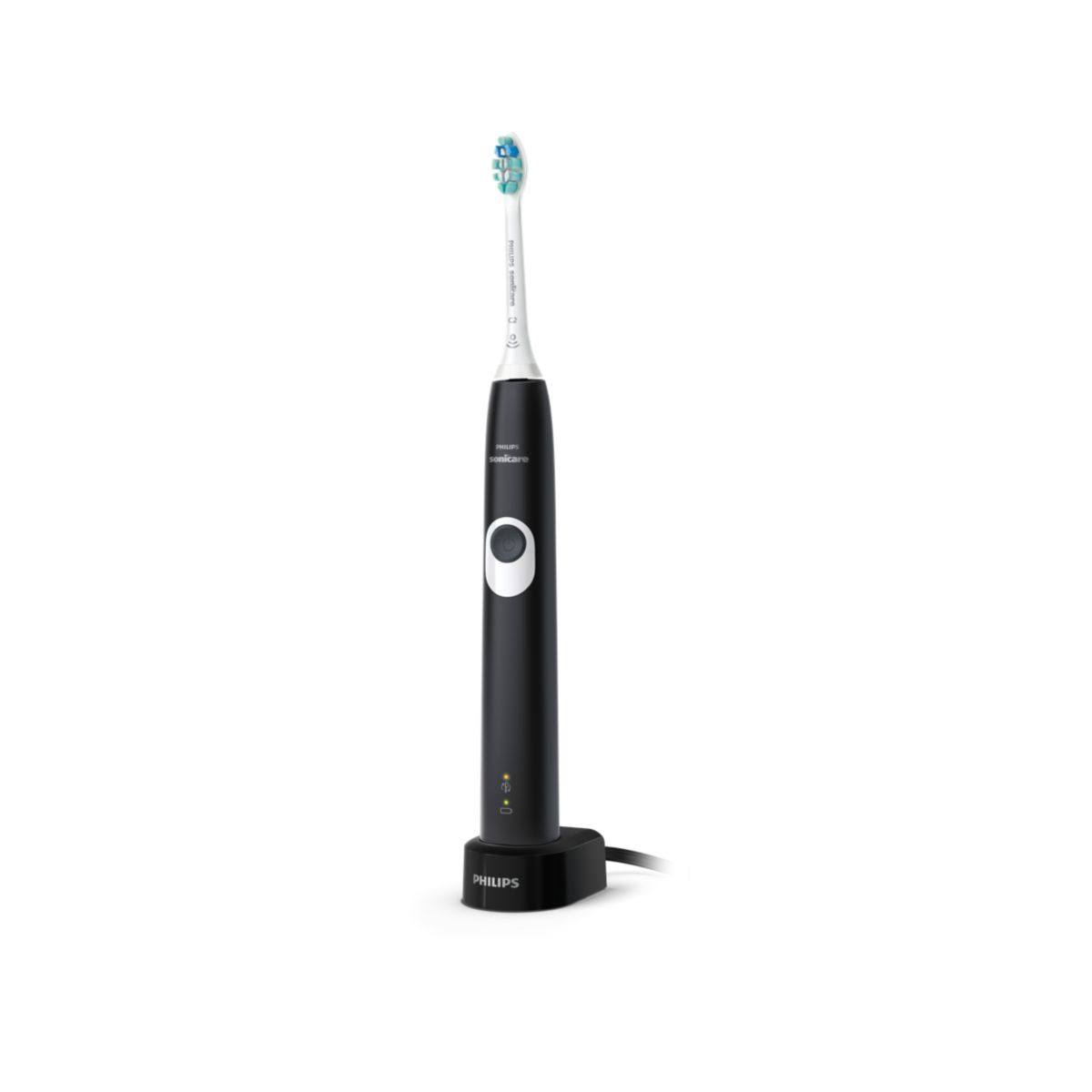
The 4100 Series feels like a proper dental instrument rather than a cheap gadget. Philips describes the handle as a slim ergonomic design, and the all-white finish keeps the whole thing to one button and two lights.
The single-button interface keeps things simple. Press once to start; press a second time within a few seconds to switch intensity; press a third time to pause. No cycling through cleaning modes you do not need, no confusing LED sequences. There are exactly two indicator lights below the power button: a brush head replacement reminder and a battery indicator. Charging is the one place Philips has changed the 1000-4000 Series: the base now takes a USB-A cord instead of a mains plug, and Philips ships the cord and puck but states plainly that the wall adapter is not included — and is specific about what you may substitute: "Only use 5V IPX4 adapter (Type A)", from a list it names as "Philips WAA1001, WAA2001, UL or equivalent safety approved adapters".
Brush heads click straight onto the metal shaft. Philips notes in the manual that a slight gap between the brush head and the handle is normal, so do not read one as a defect.
Key Features#
Sonic Technology That Actually Cleans Deeper#
The 4100 Series drives its brush head at 31,000 brush strokes per minute. That speed creates a dynamic fluid action that pushes toothpaste and water between teeth and along the gumline, reaching spots bristles alone cannot physically touch. Philips' own wording for the result is "remove up to 7x better plaque from your teeth and along the gum line while protecting your gums", and the box prints the same figure as "up to 700% better plaque removal" versus a manual toothbrush.
That is a single claim covering both surfaces rather than two separate numbers, and the gumline half is the one that matters more: the gumline is where plaque turns into the problems your dentist charges you to fix, and it is the exact place bristle contact alone does the least. Check current pricing: View on Amazon
Pressure Sensor That Protects Your Gums#
Brushing too hard is one of the most common mistakes people make, and it leads to gum recession and enamel wear over time. The 4100 Series includes a pressure sensor that sends a short vibration pulse through the handle when you push too hard. It is subtle enough that you notice it without being startled, but distinct enough that you learn to ease off naturally.
This feature matters most for people switching from manual toothbrushes. Manual brushing rewards pressure because stiffer strokes feel like they are doing more work. Sonic brushing works the opposite way. The motor does the cleaning, and your job is to guide the brush head gently along each surface. The pressure sensor retrains that instinct within a few days.
BrushSync Replacement Reminders#
Worn brush heads clean less effectively, but most people forget to replace them on schedule. Philips' baseline instruction is blunt — "Replace Philips Sonicare brush heads every 3 months to achieve optimal results" — and BrushSync refines that for you: Philips says the handle "tracks the wear of your brush head" from how often and how hard you brush, and when the moment arrives the replacement reminder light lights up amber.
You do not need an app or Bluetooth connection for this. The tracking happens entirely in the handle and a microchip in the brush head, and Philips notes the feature only works with Sonicare smart brush heads carrying BrushSync. If you find the reminder annoying, it can be deactivated: stand the handle on the plugged-in charger and hold the power button down until you hear a series of two short beeps, which the manual times at 5 seconds.
Guided Timer with QuadPacer#
Dentists recommend brushing for two full minutes, and hitting that reliably by feel is harder than it sounds. The 4100 Series solves it with SmarTimer, which Philips describes as indicating "that your brushing cycle is complete by automatically turning off the toothbrush at the end of the brushing cycle" and which the listing frames as telling you when you have reached two minutes. QuadPacer divides the session into four sections and prompts you every 30 seconds to move to the next quadrant of your mouth; Philips ships it already activated.
This systematic approach ensures even coverage. No more spending 90 seconds on your front teeth and 10 seconds on the hard-to-reach molars in the back.
EasyStart Gentle Power Ramp-Up#
If you have sensitive teeth or gums, the sudden intensity of a sonic toothbrush can feel jarring. EasyStart gently increases the brushing power over your first 14 brushings, giving your mouth time to adjust, and Philips ships the 4100 with the feature already activated.
There is one line in the manual worth knowing before you leave it that way: Philips states that to achieve clinical efficacy, EasyStart needs to be deactivated, and that in clinical studies the handle should be fully charged with EasyStart off. Treat it as an onboarding ramp rather than a setting you keep. To switch it off, stand the handle on the plugged-in charger and hold the power button down until you hear a single short beep, which the manual times at 3 seconds. The hold length is what picks the feature: 5 seconds and two beeps toggles the brush-head reminder instead, 7 seconds and three beeps toggles the pressure sensor.
Low and High Intensity#
This is the detail the listing advertises as "2 Brush Settings", and it is worth being precise about what it means. Philips lists a single cleaning mode, Clean, with two intensity settings layered on top: the manual says the handle "gives you the option to choose between low and high intensity", and that low is the default the first time you switch it on. You change it by pressing the power button a second time within a few seconds of starting. That is not a menu of cleaning programmes, but it is enough to run the brush gently through a sensitive week and at full power the rest of the time.
Technical Specifications#
Motor Speed : 31,000 brush strokes per minute
Battery Type : Lithium-ion rechargeable
Battery Life : Up to 14 days on a single charge
Charging : DC5V over a USB cord and charging puck; wall adapter not included, and Philips specifies a 5V IPX4 Type A adapter from its approved list
Timer : SmarTimer, which switches the handle off at the end of the brushing cycle, plus QuadPacer every 30 seconds
Modes : One cleaning mode (Clean), with low and high intensity settings
Brush Head : C2 Optimal Plaque Control (click-on, BrushSync compatible, 3-month replacement interval)
Pressure Sensor : Yes, vibration alert when pressing too hard
Safe For : Braces, fillings, crowns, veneers
Color : White
Model Number : HX3681/23
Warranty : 2-year limited
In the Box : 1 Sonicare 4100 Series handle, 1 C2 Optimal Plaque Control brush head, 1 USB charger (wall adapter not included)
Pros & Cons#
Pros:
- Philips rates it at up to 7x better plaque removal than manual brushing, from teeth and along the gum line
- Pressure sensor protects gums and enamel from heavy-handed brushing
- 14-day battery life eliminates charger clutter and works well for travel
- BrushSync tracks brush head wear without needing an app or Bluetooth
- EasyStart ramps power over the first 14 brushings, making the transition from manual brushing comfortable for sensitive mouths
- Low and high intensity settings on one simple button
- USB charging cord instead of a fixed mains base, so it travels without a proprietary brick
Cons:
- One cleaning mode only — the two settings are intensity levels, not gum care or whitening programmes
- EasyStart ships switched on, and Philips states its cleaning claims hold only with EasyStart deactivated — you have to turn it off yourself
- No travel case in the box; Philips lists one for specific models only
- The wall adapter is not included, and Philips restricts you to a 5V IPX4 Type A adapter from its approved list rather than any charger you own
- Replacement brush heads cost more than manual toothbrush heads
- No Bluetooth or app connectivity for tracking brushing habits over time
Final Verdict#
Buy it. The Philips Sonicare 4100 Series delivers dentist-recommended sonic cleaning technology without charging for premium features most people never use — just remember to switch EasyStart off once you are used to it, and to supply an approved 5V wall adapter.
Our recommendation: Start here if you have never owned an electric toothbrush. The pressure sensor and EasyStart program make the transition painless, and the 14-day battery means you can travel with it — just pack an approved 5V adapter, because Philips does not put one in the box. Check it out: View on Amazon